The investments down
Construction costs of buildings are recognized by the national accounts as capital expenditure for the economy. As a proportion of total investment, it turns out that construction costs are relatively high, and have hovered around 66-70% over the past four years.
In contrast, capital expenditure on property of equipment and machinery have remained relatively low, that is to say around 30-34% only. However, economists often admit that it is the investment in capacity, that is to say, the acquisition of new technologies and human capital development, which really stimulate economic growth.
We know that projects IRS / RES slowed in recent years. Similarly for 'shopping malls', which have sprung up like mushrooms. Or the plethora of road projects that boost investment.
Once completed these projects, the problem of stimulating investment should become the priority of local authorities. Industry weaknesses exist in the investment. For example, during the last four years, figures from the BCS show a deficiency in the manufacturing sector. In 2008, investment in the manufacturing sector in Mauritius stood at Rs 7.1 billion and represented a share of 10.5%. During the next four years, from 2009 to 2011, manufacturing investment has declined steadily, rising to Rs 6.4 billion in 2011, representing a small share of 7.8% in total investment. Local authorities have implemented various programs, such as the Leasing of Equipment and Modernisation Scheme (LEMS), to facilitate the modernization of the productive local firms.
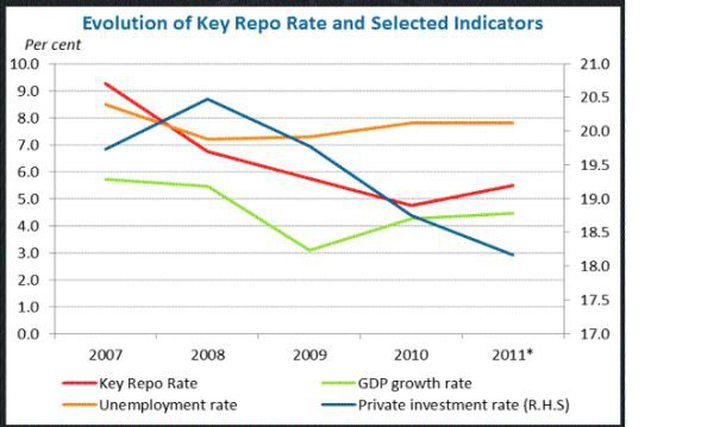
Investment stagnated. The BCS provides a growth of about 3.6% of investments in 2011, after falling 0.7% last year. The investment depends on several factors, such as access to credit, especially the 'mood' of entrepreneurs, namely their ability to collect profits in the future. Only business confidence can reassure investment. The Repo Rate of the central bank affects the level of local investment in theory.
However, according to data from the BCS, private investment has stagnated over the past two years. Public investment can not alone drive the growth of the economy, since it is private investment that represents the largest share or 73.2% of investments in Mauritius. What is needed therefore is a real engagement between the private and public sector investment to restart.

In the above charts, pie charts show that the buildings are the main component of investment in Mauritius.
The second graph shows that the rate of investment is down (blue line). This table was presented by Rundheersing Bheenick, Governor of the Bank of Mauritius, at the press conference following the status quo of the interest rate of the economy, the Repo Rate.