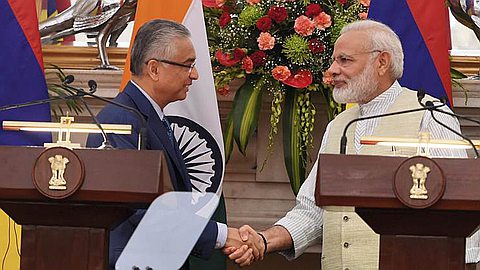
News Analysis: India-Mauritius Relations Hit New Low
The decision comes less than three months after Port Louis expressed its displeasure with India's request to the United Nations to have rights to exploit resources in what Mauritius considers its territorial waters without its authorization.
Officially, the reason given for the cancellation of the three- day meeting which was considered as crucial for Mauritius' offshore sector was the non-availability of India's head of delegation. But his absence on the eve of the start of the meeting came as a surprise to many.
Sources privy to the matter said India's decision could have been reached due to last week's remarks on the treaty by Mauritius Prime Minister Navin Ramgoolam during the World Economic Forum in Davos.
During the world economic forum in Switzerland, the Mauritius premier met with India's Finance Minister Palaniappan Chidambaram.
In their talks, Ramgoolam was reported to have expressed his displeasure with India's position on the tax treaty, especially the amendments India was proposing, and vowed that that will not happen.
"I held a meeting with minister Chidambaram and informed him we were not happy with the manner in which the talks were being conducted. I do not think that the way the negotiations are being done is correct, and I made this clear to him," Ramgoolam said on Mauritius radio and television.
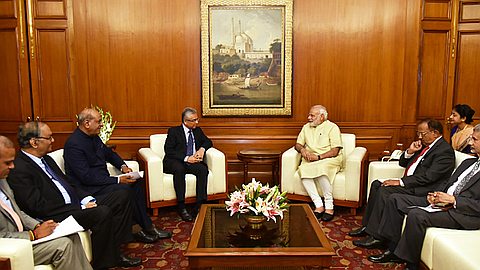
In Davos, Chidambaram and India's Prime Minister Manmohan Singh attempted to assure Ramgoolam that no decision which is unfavorable to Mauritius will be taken.
But the position of the Mauritius prime minister seems to have angered New Delhi which did not give the new date for the forum which entered into its eighth year since the creation of the Joint Working Group that supervises the treaty's implementation.
India receives about 40 percent of its foreign direct investments from Mauritius. At the same time, about 40 percent of India's financial influx from the Financial Institutional Investors (FII) is estimated to come from Mauritius.
India has expressed fears that its investors use the Mauritius financial platform to evade paying tax, and it wants to modernize the treaty, which is about two decades old, to prevent its abuse.
But Mauritius has condemned the repeated attacks from the Indian press over the treaty.
Similarly, in the month of October last year, India requested the United Nations for permission to exploit mineral resources in the zone claimed by Mauritius as its territorial waters.
Mauritius reacted through its fisheries minister, arguing that it did not appreciate the fact that India wanted to exploit its resources without asking for its permission.
New Delhi has not yet responded to Mauritius demand for explanation on its request before the UN.